STALL NUMBER ONE: NOTES FROM A PUBLIC RESTROOM IN LATE-STAGE AMERICA
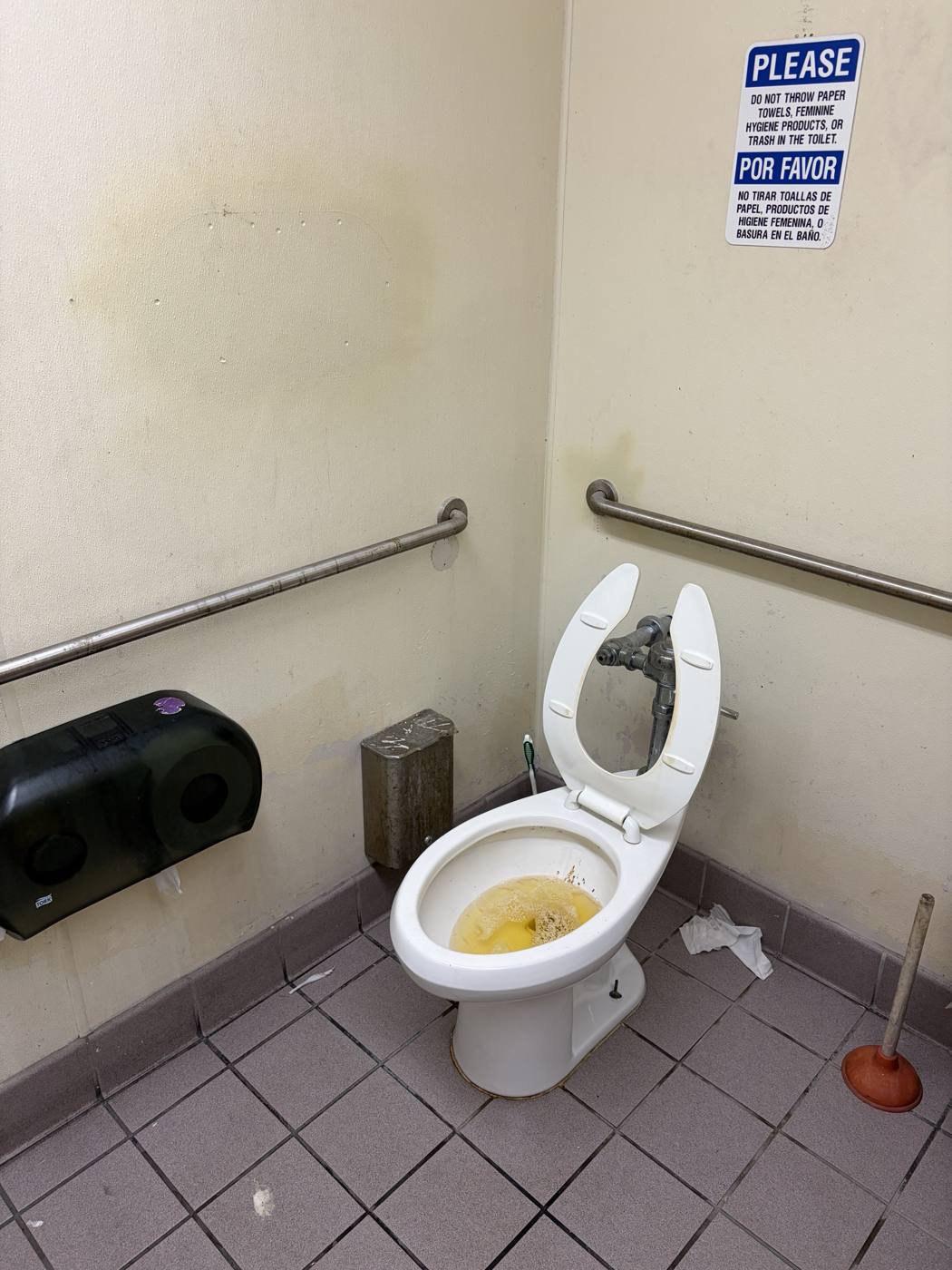
I came through the door on assignment and stopped cold. There are moments in this line of work when a man realizes he is not reviewing a bathroom so much as documenting a failure of civilization, and this was one of them.
The toilet had not been flushed. Not recently, not accidentally, but with the settled confidence of a fixture that has been left that way long enough to qualify for historic landmark status and a modest tax abatement. I will spare the reader the particulars. It is enough to say that the last patron had walked away from his responsibilities, and nobody on the payroll had stepped in to cover for him. This is not a cleaning problem. Cleaning problems happen at 4 p.m. on a busy Saturday. This is a management problem, and management problems are always moral problems wearing a cheap tie.
Consider the flush valve. Commercial-grade chrome, a Sloan-type unit that costs more than the people who should be maintaining it earn in a week. It works. It is designed to work for decades. Somebody paid good money for a machine that does its entire job with one push, and the whole system still collapsed because nobody downstream of the purchase order gives a damn. That is the American business model in a single pipe.
The open-front seat was raised and stained along the inner edge. The base was missing a bolt cap, and the seam where porcelain meets tile had turned black. The grout looked like it had not met a brush since the building was permitted. I noted scattered white debris on the floor and crumpled tissue beside the toilet, and I declined to investigate further. A journalist has obligations, but they are not unlimited.
Then the sanitary bin: a stainless box gone to rust, streaked with dried splatter. Next to it, against the wall behind the toilet, a toothbrush. I have covered political conventions, motorcycle gangs and the Kentucky Derby, and I can tell you without hesitation that this toothbrush is the most frightening object I have encountered in a public building. I don't know whose it was or what it was used for, and I want it understood that I will never find out.
The Tork dispenser held two rolls' worth of nothing, with paper stubs hanging underneath like the last argument of a defeated man. Somebody had stuck a purple decal on it, the lone sign of human personality in the room.
In the corner stood the plunger, red cup, grimy handle, left out in plain view. Nobody leaves a plunger on display unless they expect to need it again soon. It is the establishment's one honest disclosure.
The bilingual sign deserves its own paragraph. In English it forbids paper towels, hygiene products and trash in the toilet. In Spanish it forbids trash in the bathroom, which, given the floor, is a rule this place has never once enforced. Management printed a contract with its customers and then breached it in both languages.
The ADA grab bars, to their credit, were present and attached. So the owners will spend money when a federal statute and a plaintiff's lawyer are involved. They simply won't spend it on a mop.
To whoever runs this place: your restroom is your reputation with the plumbing exposed. Clean it, staff it, and for God's sake get rid of the toothbrush.
SCORE: 1 plunger. Awarded solely to the grab bars.